Get paid for the work you already put in place.
Most of what holds up a pay app is paper. A sub's lapsed COI. A W-9 nobody collected. A lien waiver nobody chased. A change order that got agreed to on the phone and never written up. Contractor-AI keeps all of it on one project record, flags what's missing before the pay app goes out, and drafts the chase emails your PM doesn't have time to write.

- years on jobsites and in job trailers
- 25
- years running a region for a $500M GC
- 10
- in active work carried at once
- $60M+
- people led
- 30
Built by people who have carried a job from notice to proceed to final payment. One client cut bookkeeping from 8 hours a week to 1. That's over $60,000 a year they're not paying for data entry.
Where to start
Turn on the piece that's costing you money. Add the rest when you get to it.
Some outfits start with contracts and billing because that's where the money is stuck. Others start with crews and material. Every module you add later reads the same project record, so nobody keys the same job in twice.
Chat
Ask a question on any page and get an answer from that job's own records. It drafts the emails too.
Project Management
Contract, SOV, change orders, RFIs, submittals, drawings, budget, punch and closeout.
Accounting
Every invoice gets coded to the job and signed off by two people before a dollar goes out. Your books stay in QuickBooks.
Field Daily
Who's on which job tomorrow, and the daily report from today.
Epic Inventory
What material is on which job, the BOM behind it, and the compliance paper.
EagleEye
Spot the job that's bleeding before the WIP report tells you. Every number shows where it came from.
BidWatch
Public bids in North Carolina, South Carolina and Virginia, filtered down to the ones you can actually chase.
Field Daily is on only when that module is on for your company.
Project management
From award to the final unconditional waiver.
This is the module that decides whether the job makes money. It carries the contract from award to final payment.
Contracts and money
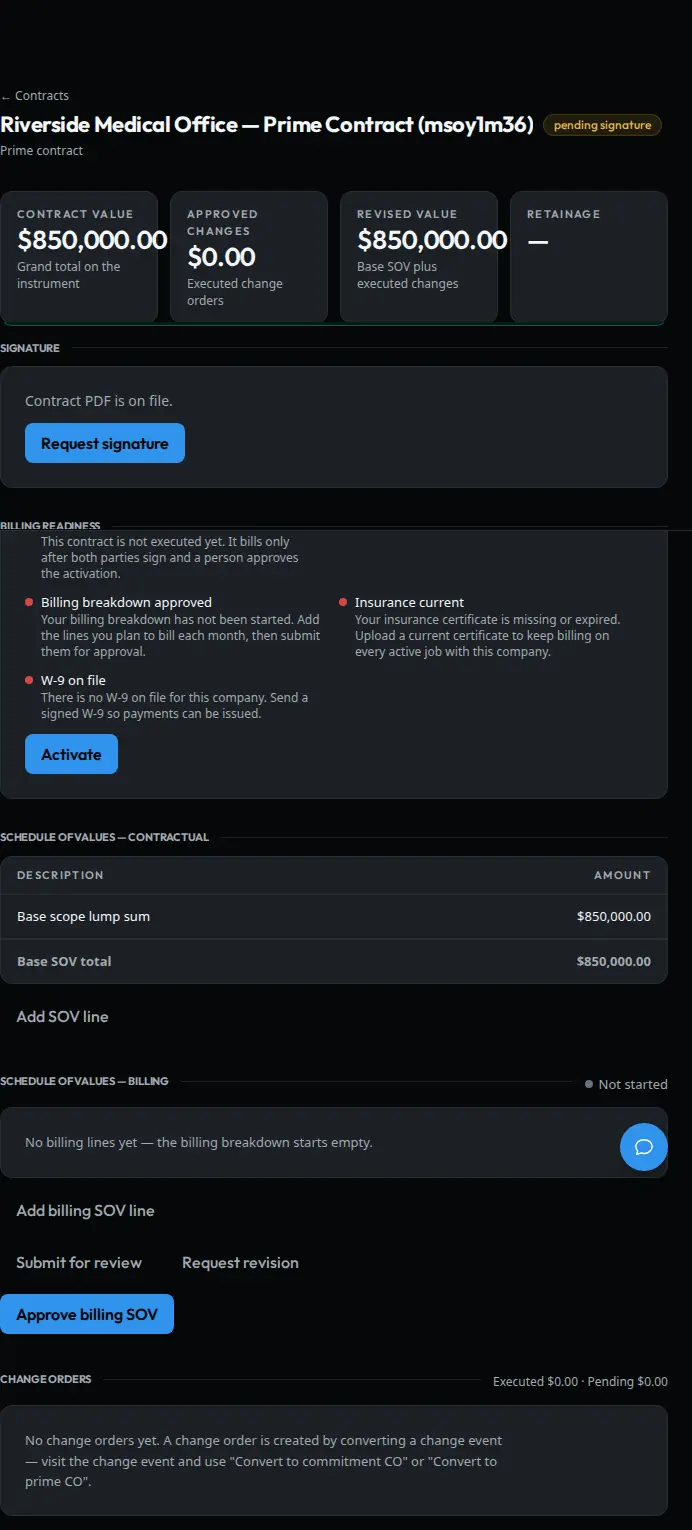
No pay app goes out with a hole in the backup
The contract, its SOV, approved change orders, funding and billing history sit on one screen. If a sub's W-9 or COI is missing, or the billing breakdown isn't done, the system holds the pay app until it is.
- SOV with approved change orders rolled in
- Billing holds for a missing W-9, lapsed COI or unfinished billing breakdown
- Signatures collected in the same system
- Pay apps, lien waivers and closeout in the same module
One queue
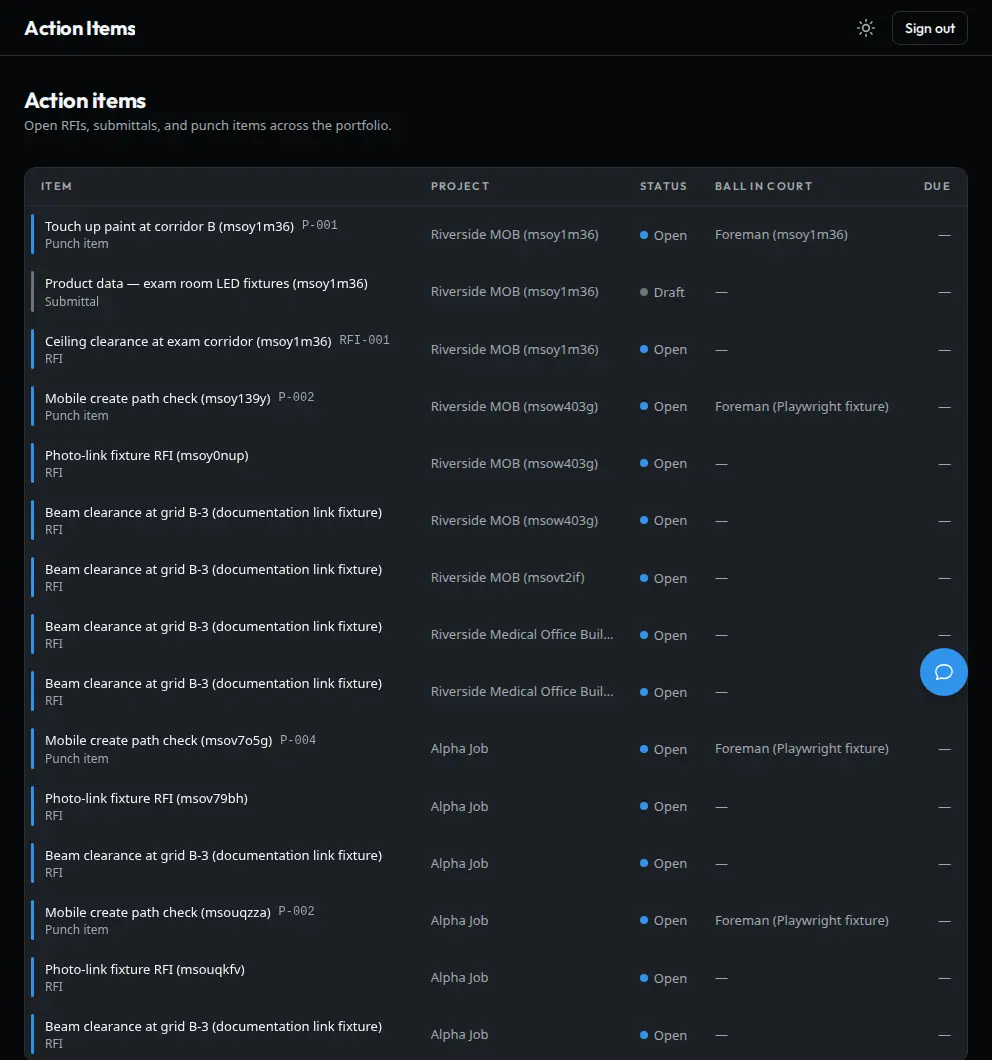
Everything holding up the job, on one list, with a name next to it
Every open RFI, submittal and punch item lands on one list with the ball-in-court name on the row. Your PM works the list top to bottom instead of digging through six screens to find out who's sitting on what.
- RFIs, submittals and punch on one list
- Ball-in-court on every row
- Click the row and you're in the record
The assistants
Run more jobs with the office you've got.
You can't find a PE to hire, so your PM is doing PE work at 7 PM. The assistant drafts the RFI chase, the sub chase and the OAC minutes from the live job record. Your PM reads it and sends it. It runs on AI, and nothing goes out without a person's name on it.
Nancy
Nancy works in the platform and in your own Microsoft Teams. She reads the live job, drafts the chase emails and the meeting minutes, and writes the Word, Excel and PowerPoint files straight into your OneDrive or SharePoint. You read what she wrote and you send it.
See what she doesAmy
Amy works inside Procore. She reads the drawing set and the schedule, pulls the RFI and submittal history, and drafts the next one. Your PM stops clicking through six tools to answer one question from the field.
See what she doesConsulting
The person who built it has read the same job cost reports you have.
“I come from construction. I understand job cost reports, WIP schedules, AIA billing, and why sub compliance matters to your bonding capacity. This is not a tech pitch. It is an operations system built by someone who reads the same reports you do.”
Field notes
Notes from the trailer.
Why I Left Harper: 10 Years at a $500M Firm
After ten years as Regional Director at one of the Southeast's largest general contractors, I walked away. Here is what led to that.
When AI Won't Replace Construction
It does some things well and some badly. What it can't do on a jobsite, and why that matters more than the hype.
The AI Implementation Failure Nobody Talks About
Most rollouts in construction die after the pilot. The rollout usually ignores how a construction team works.
Next step
Bring a job you're carrying right now.
We run the walkthrough on your own contract and your own open items, so you see what it does with your paper instead of ours.